
GPT Translator Logo
Login

Why Translation Quality Drops in Long Documents

February 11, 2026
Updated: February 11, 2026

Why Translation Quality Drops in Long Documents

Why Translation Quality Drops in Long Documents
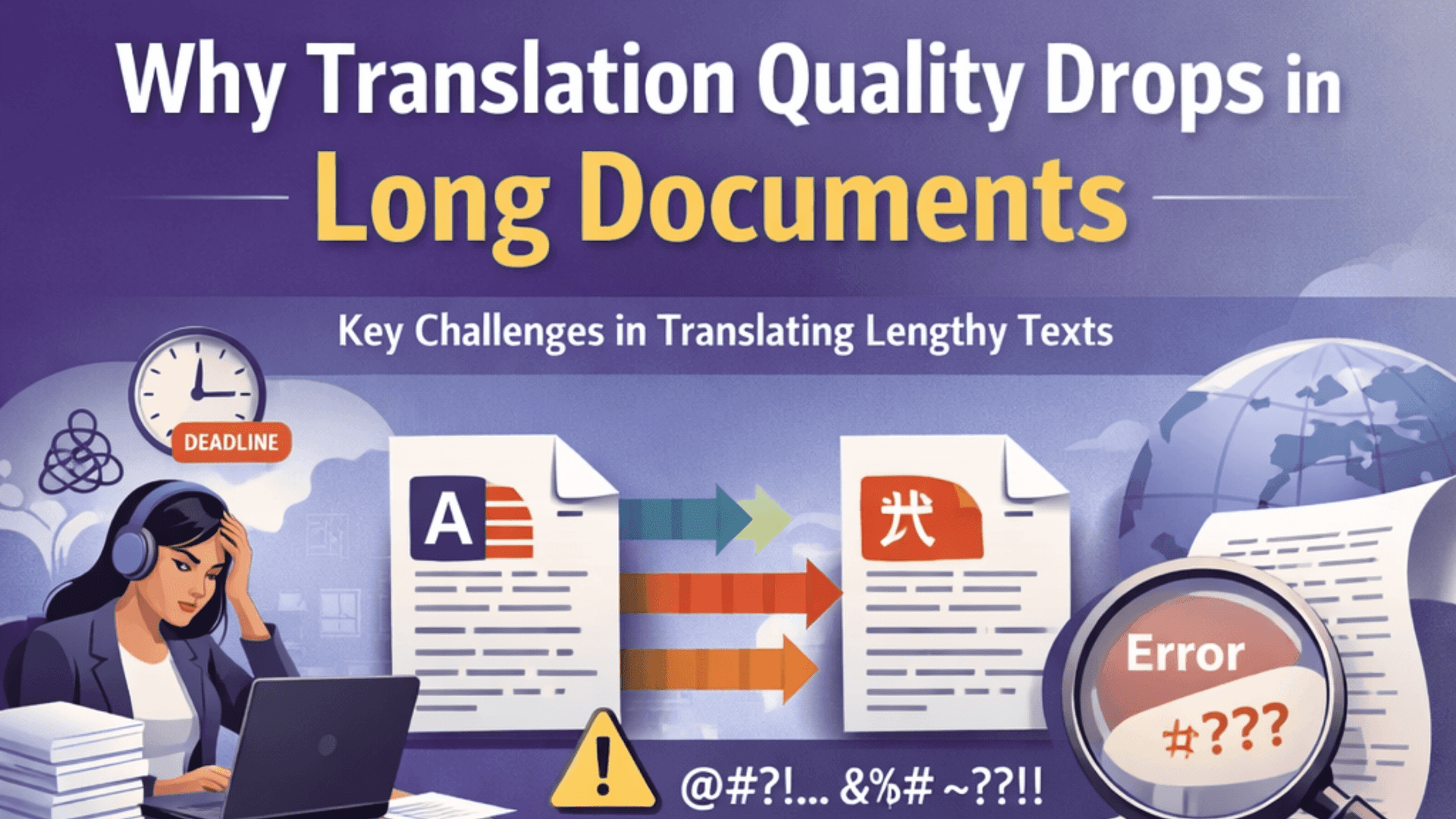
The first page of a 100-page document may appear perfectly translated, yet by page eighty the content becomes confusing. Readers often face this issue when reviewing reports, contracts, manuals, or research papers. At the beginning, the ai translation feels accurate and reliable. As the document progresses, new terms appear, tone shifts subtly, and meaning becomes harder to follow. This is not accidental. It reflects the limitations of many document translation processes when handling extended content.

Why Length Changes Everything

Short text can tolerate small inconsistencies. Long documents cannot. As content grows, maintaining translation quality becomes increasingly difficult. Each section depends on previously established concepts, terminology, and tone. When these elements drift, comprehension suffers.

Most machine translation and automated translation systems treat documents as isolated segments. They do not reliably track earlier terminology choices or tonal patterns introduced at the beginning. This directly leads to context loss in translation, especially in technical, legal, or structured documents.

Industry Challenges in Long Document Translation

Inconsistent Terminology

One of the most common problems in long document translation is terminology inconsistency. A key term may be translated one way in the introduction and differently later in the document. This confuses readers and reduces trust, particularly in legal, medical, and technical materials where precision is essential.

Tone Changes Over Time

Tone often shifts without notice. Formal language gradually becomes casual, or instructional content loses clarity. These shifts reduce translation accuracy and make the document feel fragmented rather than cohesive.

Formatting Breaks

As documents grow longer, tables, headings, references, and numbered sections often break. Even when language remains mostly correct, inconsistent formatting makes content harder to follow and lowers perceived quality.

Missing or Misaligned Sections

Long documents are also prone to skipped sections, duplicated content, or partially translated paragraphs. These issues commonly arise in automated translation workflows that lack document-level validation.

Consistency From Start to Finish

High-quality translation should feel stable from the first page to the last. Readers should not notice shifts in word choice, tone, or structure. True translation consistency allows ideas to remain connected and terminology to stay predictable across sections.

This perspective treats long documents as unified systems rather than collections of paragraphs. Maintaining meaning, structure, and author intent across the entire document is essential for reliable translation.

A Smarter Approach to Long Document Translation

Use a Terminology Glossary

A predefined glossary ensures that key terms are translated the same way throughout the document. This significantly reduces terminology inconsistency and improves overall translation quality.

Maintain a Consistent Tone

Tone guidelines help preserve the same writing style across all sections. Professional documents depend on tonal stability to maintain credibility.

Preserve Formatting and Structure

Headings, lists, tables, and references must remain intact. Formatting supports comprehension and strongly influences how readers judge translation quality.

Check for Consistency Across Sections

Rather than reviewing translations line by line, consistency checks should compare how concepts are handled across the entire document. This helps detect translation quality issues early.

Consistency at Scale

The real breakthrough in long document translation occurs when consistency becomes automatic rather than manual. This is where GPT Translator plays a critical role.

By tracking terminology, tone, and structure across the entire document, GPT Translator maintains alignment from start to finish. Instead of treating each section independently, the system preserves context across pages, reducing meaning drift as documents grow longer.

This approach minimizes context loss in translation and produces content that feels intentional, professional, and reliable throughout.

Key Elements That Improve Translation Quality

Glossary Management

Consistent term usage forms the foundation of accurate long document translation and reduces confusion across sections.

Tone Tracking

Monitoring tone prevents subtle shifts that can undermine clarity and reader trust.

Formatting Preservation

Maintaining layout and structure ensures translated documents remain readable and professional.

Step-by-Step Process for Better Long Document Translation

Step 1: Prepare a Glossary

Define essential terms before translation begins to establish a shared vocabulary across the document.

Step 2: Translate in Logical Sections

Breaking content into structured sections helps GPT Translator retain context and deliver more consistent results.

Step 3: Maintain Formatting

Layouts, numbering, and references should remain unchanged throughout the translation process.

Step 4: Perform a Final Consistency Review

Review the entire document for tone shifts, repeated errors, and cross-section inconsistencies.

Real-World Impact of Consistent Translation

When consistency is preserved, documents become easier to read and more trustworthy. Reports sound professional. Legal and technical documents reduce the risk of misinterpretation.

Organizations experience fewer revisions, faster approvals, and stronger multilingual communication. These gains come not from translating faster, but from translating smarter and reducing context loss throughout long documents.

Closing Reflection

“Consistency is the key to long document translation.”

Even as translation technology advances, long documents will always demand structure, memory, and continuity. When translation maintains alignment, meaning stays intact. When it does not, quality gradually declines.

Understanding why translation quality drops in long documents is the first step toward preventing it.